


Where Detailed Orders Can Break Down
With a simpler menu, an employee may only need to confirm the item and quantity. A Sichuan order can require several additional decisions, depending on what the restaurant actually offers for that dish.
Information can become unclear at three points:
- During selection: Available choices are not presented in a consistent order.
- During order entry: Special requests depend on verbal explanations or unstructured notes.
- During preparation: Different ordering channels describe similar requests in different ways.
For this type of restaurant, a POS needs to do more than accept payment. It should help organize menu choices and keep order information easy to understand throughout the restaurant.
Staffed Ordering and Self-Ordering Work Together
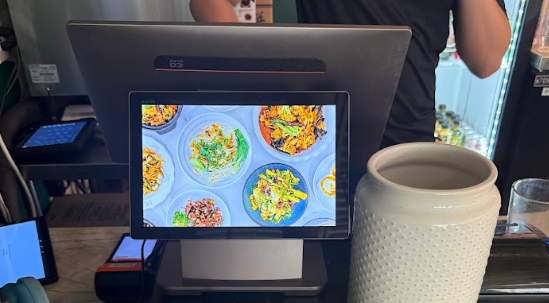
The restaurant keeps staffed ordering available at the counter while also offering two self-order kiosks. Customers can choose the experience that fits them best: those with questions can order with an employee, while customers who already know what they want can place and pay for their orders at a kiosk.
Orders from the counter, kiosks, online ordering, and connected delivery channels can be managed within the same operating environment. Employees spend less time comparing separate devices, while item selections and customer notes remain easier to follow through the preparation process.
The kiosks are not meant to replace service. They create another ordering option while allowing employees to focus on customers who need menu guidance or help with special requests.
Turning Verbal Requests Into Clear Order Details
A structured digital menu can guide the person placing the order through the choices that apply to a specific dish.
Required selections can be confirmed before checkout, optional selections can stay clearly labeled, and requests that do not fit a standard choice can still be entered as notes.
Depending on the restaurant’s actual menu, this type of setup can help it:
- Place relevant spice, size, add-on, or preparation choices under the correct dish;
- Separate required selections from optional ones;
- Preserve special instructions with the order;
- Use more consistent wording across counter, kiosk, and kitchen-facing order information.
The goal is not to add more buttons to every menu item. Each dish should include only the choices the restaurant genuinely offers. A well-organized menu makes ordering clearer without making it feel longer or more complicated.
Stable Delivery Activity Across Multiple Platforms
The restaurant’s August data and September data through September 28 show steady third-party delivery activity:
- Third-party delivery orders maintained a 100% valid-order rate in both periods;
- Daily third-party order volume changed by only about 3%;
- Average third-party order value remained nearly unchanged;
- Uber Eats was the restaurant’s primary delivery source, with additional orders from DoorDash and Grubhub.
These figures do not indicate a dramatic sales increase, and they should not be presented that way. Instead, they show a restaurant consistently handling orders from several delivery platforms while also operating its in-store ordering channels.
For a restaurant with a detailed menu, the practical value is having order sources and item information available through a more unified workflow, rather than asking employees to monitor and interpret every channel separately.
Why Menu Clarity Matters More Than Device Count
The number of terminals alone does not determine whether a POS is right for a Sichuan restaurant. The more important questions are operational:
- Can menu choices be configured around the restaurant’s real dishes?
- Are required and optional selections easy to distinguish?
- Do special instructions stay attached to the order?
- Can staff manage in-store and delivery orders without constantly switching between systems?
- Does the kitchen receive information that is clear enough to act on?
This restaurant’s setup shows how staffed ordering, self-order kiosks, and digital order channels can support one another. The value of the POS is not simply putting a menu on a screen. It is helping each selection remain clear from the moment the order is placed to the moment it is prepared.

The more detailed the menu, the more important the order structure becomes. With Front POS, a staffed counter, two self-order kiosks, and connected digital ordering capabilities, this Sichuan restaurant has multiple ways to accept orders while keeping the process more consistent.
When menu choices, special requests, and order sources are easier to understand, employees can spend less time interpreting information and more time serving guests and preparing food accurately.